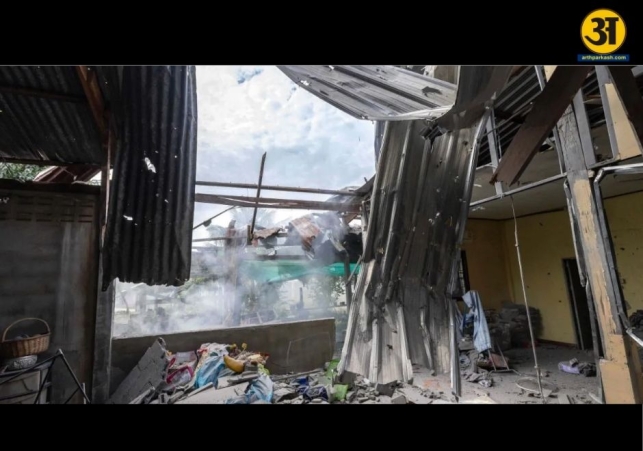
Cambodia claims new Thai airstrikes amid fragile ceasefire
Trump-brokered ceasefire hangs by a thread as Cambodia alleges fresh Thai airstrikes
- By Gurmehar --
- Sunday, 14 Dec, 2025
A ceasefire brokered by US President Donald Trump between Thailand and Cambodia has come under serious doubt after Cambodia accused Thailand of carrying out fresh airstrikes along the disputed border. The accusations came just hours after Trump announced that leaders of both countries had agreed to stop fighting and return to an earlier peace agreement.
According to Cambodia’s Defence Ministry, Thai fighter jets carried out airstrikes on Cambodian military bunkers in Trat province and other border areas. The ministry claimed that more than 165 Cambodian soldiers were killed in the attacks. Thailand, however, has said that its military actions were aimed only at specific military targets.
The renewed violence has raised concerns about the effectiveness of the ceasefire and the growing instability in the region, especially after days of intense clashes that had already caused significant casualties on both sides.
Ceasefire announcement and rising tensions
President Donald Trump announced the renewed ceasefire after holding telephone conversations with Thai Prime Minister Anutin Charnvirakul and Cambodian Prime Minister Hun Manet. Trump said that both leaders had agreed to stop all military action and return to the original peace agreement reached earlier this year.
In a post on his social media platform, Trump said that the two sides had agreed to “cease all shooting” and go back to the peace accord made with his involvement, along with mediation support from Malaysian Prime Minister Anwar Ibrahim.
ALSO READ: No shampoo can make your hair grow; here’s what they actually do
ALSO READ: The Thinking Game shows Silicon Valley is not thinking deeply about AI
The original ceasefire was reached in July and was mediated by Malaysia. It came after strong pressure from Trump, who had issued a clear warning to both Thailand and Cambodia. He had said that the United States would cut trade ties with both countries if they failed to stop the fighting.
That agreement was later expanded and formally approved in October during a regional summit held in Malaysia, which Trump also attended. Despite these efforts, tensions never fully eased. Both sides continued to accuse each other of violations, and small clashes and hostile statements kept the situation unstable.
Cambodia’s latest claim of airstrikes has now cast serious doubt on whether the ceasefire is actually being followed. Cambodian officials said Thai F-16 fighter jets were used in the attacks, marking a dangerous escalation in the conflict.
Thailand has not accepted Cambodia’s version of events fully but has confirmed the use of air power. Thai authorities said the strikes were aimed at military positions and were carried out to defend national security.
In response to the airstrikes, Cambodia reportedly deployed BM-21 multiple rocket launchers, weapons capable of hitting targets up to 30 to 40 kilometres away. This has raised fears that the conflict could spread further and become more destructive.
Background of the Thailand-Cambodia conflict
The conflict between Thailand and Cambodia has a long and complicated history. It began in 2008 over a dispute involving an ancient Hindu temple known as Preah Vihear in Cambodia and Khao Phra Viharn in Thailand. The temple dates back to the 11th century and is located near the border between the two countries.
Although the International Court of Justice (ICJ) ruled in 1962 that the temple belongs to Cambodia, Thailand has continued to claim rights over the surrounding land. This disagreement has led to repeated tensions, military stand-offs, and occasional violence over the years.
Both countries accuse each other of crossing borders and violating agreements. Nationalist sentiments on both sides have often made the issue more sensitive, with political leaders facing pressure at home to take a strong stance.
In recent months, the situation worsened due to renewed military activity along the border. Artillery exchanges, troop movements, and now airstrikes have increased fears of a larger conflict. Civilians living near the border areas have also been affected, with reports of displacement and damage to infrastructure.
International observers have urged both sides to show restraint and respect the ceasefire agreements. Malaysia, which played a key role in mediating the original truce, has expressed concern over the latest developments. Other regional powers are also closely watching the situation, as prolonged conflict could affect stability in Southeast Asia.
President Trump’s involvement in brokering the ceasefire reflects Washington’s interest in maintaining peace in the region. However, the latest accusations suggest that diplomatic efforts alone may not be enough unless both sides commit fully to dialogue and de-escalation.
As of now, it remains unclear whether the ceasefire will hold or collapse entirely. With both Thailand and Cambodia maintaining military readiness and exchanging accusations, the situation remains tense and unpredictable.
The coming days will be crucial in determining whether diplomacy can prevent further bloodshed or whether the long-running border dispute will once again spiral into a wider conflict.
Related News